Monday, May 31, 2010

Religion On The Radiowaves


"Speaking of Faith," a talk radio show from American Public Media, got some great coverage from The New York Times this week.

Creator and host Krista Tippett describes her radio show as a vocation: “I get asked if I consider this show a ministry. I do like the word ‘vocation,’ a calling. If it is a ministry, it’s a ministry of listening rather than talking.”

That, friends, is the beauty of journalism. The focus is not on the storyteller, but rather on the story-maker.

Finally, I love how Tippett describes the religion beat:
“Religion is a touchy subject. You’re really getting at the core of people’s identities, an intimate place. This religious sphere in our public life is very charged, and I want to disarm that.”


Tuesday, May 18, 2010

Cavemen, Mountain Men and Cadets: Where They Worship


Sara Pulliam, online editor of Christianity Today, tipped me off to this sweet gallery of the "50 Most Extraordinary Churches of the World."

Want to praise God in a re-vamped Shell Station? Like a moss-covered cathedral built into a hill? A chapel built from sticks or tipped upside down? This site has it all.

Sunday, April 25, 2010

Pay Up, Cash In: Do You Want Paid Content?


In my remaining weeks as a college student, I've turned to Pandora, a free custom music station, to fill my many house of paper-writing.

I'd heard a rumor or two about time limits on Pandora. Today, I faced the reality. Pandora wants me to upgrade, but I don't want to pay. Our generation has grown up online, and we've also grown up on "free" -- listening to the top hits, catching up on an episode of "30 Rock," or even designing a basic Web site.

Soon, "free" will be over. But I don't know many of my generation that will want to shell out the dough. One of my roommates decided her addiction to Pandora was too important, so she subscribed for 30 bucks a month.

Already, sites like Pandora and Facebook have broken through the advertising mold to create personalized ads (Pandora seems to think I really need X brand of birth control and the audio ads think I'm in the market for "Indiana's most affordable diamond dealer"). Plus, ads are interactive and self-selected. Facebook's got their "like" option, which allows them to give you better ads, and Hulu lets viewers choose which brand of car they want to see commercials for.

Paid content is the way of the future. Apple is already proving that with the advent of the iPad.

Credit cards - monthly subscriptions - pay-as-you-go? What will be the model for paid content in the near future?

Sunday, April 18, 2010

FIghting Crime With (My) Words

In three weeks, I will be a Butler University graduate.

In four weeks, I will be sitting at a desk.

That desk will be in an office located just blocks from the White House in Washington, D.C.

It’s pretty amazing how it all unfolded. Here it is, in a nutshell.

I visited D.C. over spring break in hopes that I could score a few job interviews (success!). During that week, I had a really great experience with an organization called Fight Crime: Invest in Kids. I interviewed with them twice that week, and quickly learned that the people there are passionate and energetic. Bingo.

There are countless non-profits that have headquarters in Washington.That said, there isn’t a single non-profit job in D.C. can be explained in less than a paragraph. Here’s my paragraph:

Fight Crime: Invest in Kids is a national organization that uses the voice of law enforcement (sheriffs, police officers, etc.) to encourage policymaking and funding for early learning programs, like HeadStart. The parent organization, Council for a Strong America, also works with branches that involve pastors, retired military officials and business leaders. The people at CSA and Fight Crime truly care about the mission. They care about kids.

So what do I get to do? Communicate! (Big surprise there, huh?) I will assist in writing press releases, organizing press conferences, writing op-eds and creating video content, and – perhaps – enhancing their social media strategy. Yes, they have a Twitter account.

Pastor Mark Batterson at National Community Church (in D.C.), recently wrote on his blog about Ephesians 2:10, which states: “We are God's workmanship, created in Christ Jesus to do good works prepared for us in advance.” Whoa. I didn't see this one coming, clearly. I have to keep that in mind as I move forward. I don’t think I’ve comprehended everything that’s happened to me in the last month, but through it all I know, that God has a plan (why wouldn’t he? He’s a pretty organized guy, even if I don’t understand his methods sometimes).

I’m blessed to have a church there, an amazing group of friends (not to replace the ones I have a Butler, just new ones!), a great network of Butler alumni and an excellent understanding of the metro system. When combined, I think it’s going to mean a great start to my grown up life in the nation’s capital.

Guess that means my D.C. blog won’t be dying anytime soon.


Tuesday, April 6, 2010

Good Dawgs Always Come Home


And they did. Since my last post, the Butler Men's Basketball team competed in the Final Four and advanced to the final NCAA championship game against powerhouse Duke University. To boot, the last round was held just six miles from campus - in Conseco Fieldhouse.

What it's like when your humble midwest university is launched into national spotlight? Well, when it's a for positive news -- such extremely positive news -- the experience is pretty surreal.

First, the student perspective: Visually, the campus perked up. Students tied blue bunting around the trees on campus, and suddenly there were snazzy banners on light posts. Someone even dyed the Star Fountain blue. The bookstore was teeming with alumni, families, prospective students and students vying for the latest Final Four t-shirt design. (Don't worry, I picked up swag for the whole family).

Then I started reading the news online. It was astounding. Each day, my Google Alerts emails got longer and longer. Most of the articles were related to the NCAA tournament, but then were articles featuring our president, Bobby Fong - and even our pampered pup mascot Blue II. In a period of two weeks, we gained home page news coverage on Web sites like NPR, The Washington Post, The New York Times and more. Our local CBS affiliate, WISH TV, made daily appearances on campus. Our own sports writers from The Butler Collegian received countless media requests and interviews.

As I started to realize the magnitude of attention Butler was drawing, it dawned on me that campus felt different. There was an invisible, but very elevated sense of excitement - of community - of unity. I can't pin it to one person or one moment

I watched the final round right home at historic Hinkle Fieldhouse. It was fitting, too - the place where "Hoosiers" was filmed so long ago, now served as a movie house to watch one of the most historic basketball games our school has seen.

So we lost to Duke. To their credit, they played a mean game. To our credit, we played harder. It was beautiful, even in the midst of the final score.

President Dr. Bobby Fong cancelled class the day after the game (and that was before we knew who won!). Tuesday was quiet on campus - students were recovering from the excitement, the national attention and the celebrations. That afternoon, thousands of students, faculty, staff and neighbors clamored into Hinkle Fieldhouse - not to watch another game, but to celebrate our team.

I'm going to be sappy and say I was near tears the entire pep rally. The team truly brought the campus together. Even Butler alumni from D.C. and around the country rallied to Indianapolis for the celebrations. It was like one big Butler reunion.

Looking back on March Madness, the timing couldn't have been more perfect.
In the wake of the game, Coach Brad Stevens appeared on the the David Letterman Show (Full disclosure: Letterman is an Indianapolis native!). Gordon Hayward accepted a NBA draft pic. "Butler" was a trending topic (WORLDWIDE) on Twitter (for several minutes anyways) - that made my day. The basketball seniors got to play with the Harlem Globetrotters and the team has been made Grand Marshals for the Indy 500. We're too big, yo!

Sad news: Our campus fountains are no longer dyed blue.

Happy news: Coach Stevens just signed a 12-year contract to stay with Butler!

Want a recap of the campus energy during March Madness? Just watch this.


Saturday, March 27, 2010

Too Big Yo


The Butler Bulldogs did it. We made it to the Final Four - for the first time in history. Conveniently, the Final Four will be held in our own backyard. Now for the headlines:


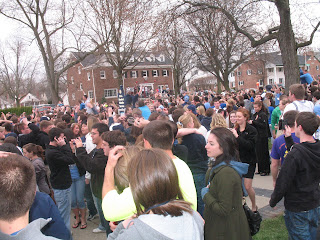
Here's what the campus celebration looked like:

With two of my good friends Christina and Hope.

Celebrating in our lecture hall. We watched the game on TV. It was a stampede out of the building and into the streets.

Students flooded the streets after we won the game.

Yes, that's President Bobby Fong crowd surfing.


And, if you're not acquainted with the "Too Big Yo" internet meme, it's a rap song written and produced by a few of our Butler basketball players. Even the cheerleading squad has jumped on board with a few of their own music videos.

Now, our boys are headed back home. We'll welcome them back at 1 AM Sunday morning and then gear up for the Final Four. Indianapolis is going to be ablaze this week!

Tuesday, March 2, 2010

Technology & the Liberal Arts


The following is an essay I submitted for the Butler Liberal Arts & Sciences 2010 essay contest. The contest posed the question:

New technologies and social media offer the public a myriad of options for reading and writing, and the sharing of opinions and experiences has never been easier or more immediate. But the immediacy and ease of publication is fraught with pitfalls and potential issues that provide new challenges for the next generation of readers, writers, and thinkers. Consider the place of your liberal arts education in this mix and write an essay in which you analyze how that education has better prepared you as a consumer of, contributor to, and critic of the texts that flow from new media outlets.


I sat in a boardroom at National Public Radio listening to news executive Dick Meyer talk about his career. His story sounded like other accomplished journalists I’d heard speak: he started in a traditional newspaper background. He rode the wave of technological changes and the Internet boom of the nineties -- and still maintained his journalistic foundation.

The interns sat around the table, attentive to Mr. Meyer’s words. We wanted insight into our future – a future that seemed potentially dismal in the midst of a recession and some of the biggest changes the journalism field has ever seen. Perhaps Mr. Meyer could impart wisdom that would unlock the keys to our success.

That’s when I asked him about the future of journalism.

“I don’t have the answers for you. It’s up to your generation to figure out how to do journalism.”

His answer was short, and it was not what I wanted to hear - at least, not at first.

As I thought about his answer, I realized that I have all the essential tools to figure it out how to adapt to new technologies. I’m not alone, either. My entire generation will move into adulthood - into this economy - with the combined skills and efforts that a four-year institution has helped us develop.

I glanced around at my colleagues. I was reminded of how diverse each of our educations was. All of us had traveled to Washington, D.C. from small private colleges, Ivy Leagues, Big Tens, and everywhere in between. We weren’t all journalism majors, either. We studied government, literature, gender, psychology and biology. We were a cornucopia of experiences, personalities and ideas, with a passion for storytelling.

Unless you’re a fortune-teller, there’s really no way to predict how society and technology will adapt to any changes headed our way. A seasoned journalist won’t have the answers for me. My professor won’t have the answers for me. But they’ve all given me a foundation for me to tackle the answers on my own.

In a future where the very foundations of media appear to be shaken, it’s important to remember that storytelling still has a role, no matter what the technology is. Marshall McLuhan so aptly put, “The medium is the message.” My storytelling skills will mature because of reporting classes, but also from a course on Islam, a seminar about doubt and reason, and even from a project researching housing costs in Indianapolis. It’s those courses - outside the periphery of my main studies - that will make my education that much richer.

The economy is uncertain, and so is the future of media. But no generation has ever known anything with absolute certainty. Instead, the past can aid us in making decisions in the present that will affect us in the future. Liz Coleman, president of Bennington College, said last February, “History provides a laboratory in which to see the actual as well as the intended consequences of ideas.”

We can thank our grandparents - our ancestors – for giving us that blueprint for the future. In the fabric of our society exist potential solutions for conflict, theories on ethical dilemmas – because others have tried it before we have. My History and Literature of Journalism class won’t tell me how to best reach audiences with the newest technology, but it will provide a critical foundation to equip me with tools for the future.

Coleman, a great innovator in preserving the liberal arts, said, “when making connections is of the essence, technology emerges with special intensity – but so does the importance of content.” If we incorporate something akin to Apple’s iPad into the classroom, we need to make sure that the content in that medium, whether news or literature or scholarly research – is still of substance.

No matter what vehicle will carry journalism into the future, we still need communicators with critical thinking skills, but we also need communicators who can also be good listeners. There are stories to be told. Lives to be chronicled. Imaginations to illuminate.

Back in the boardroom, I mused about my colleagues’ futures. From our diverse educations will spring forth communicators – men and women - in radio, television, and newspapers. It won’t stop there, either. One of the interns plans to attend law school, and another wants to start her own photography studio.

Mr. Meyer reminded us to keep an open mind and to never lose sight of the journalism’s foundation: the ability to observe, think critically and report the truth. That foundation, I believe, is what will sustain our society, whether informed by word-of-mouth, a smart phone or a message in a bottle.