Saturday, March 27, 2010

Too Big Yo


The Butler Bulldogs did it. We made it to the Final Four - for the first time in history. Conveniently, the Final Four will be held in our own backyard. Now for the headlines:


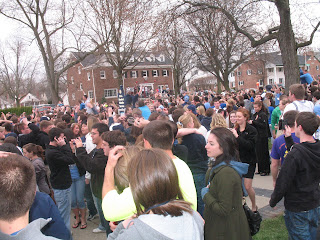
Here's what the campus celebration looked like:

With two of my good friends Christina and Hope.

Celebrating in our lecture hall. We watched the game on TV. It was a stampede out of the building and into the streets.

Students flooded the streets after we won the game.

Yes, that's President Bobby Fong crowd surfing.


And, if you're not acquainted with the "Too Big Yo" internet meme, it's a rap song written and produced by a few of our Butler basketball players. Even the cheerleading squad has jumped on board with a few of their own music videos.

Now, our boys are headed back home. We'll welcome them back at 1 AM Sunday morning and then gear up for the Final Four. Indianapolis is going to be ablaze this week!

Tuesday, March 2, 2010

Technology & the Liberal Arts


The following is an essay I submitted for the Butler Liberal Arts & Sciences 2010 essay contest. The contest posed the question:

New technologies and social media offer the public a myriad of options for reading and writing, and the sharing of opinions and experiences has never been easier or more immediate. But the immediacy and ease of publication is fraught with pitfalls and potential issues that provide new challenges for the next generation of readers, writers, and thinkers. Consider the place of your liberal arts education in this mix and write an essay in which you analyze how that education has better prepared you as a consumer of, contributor to, and critic of the texts that flow from new media outlets.


I sat in a boardroom at National Public Radio listening to news executive Dick Meyer talk about his career. His story sounded like other accomplished journalists I’d heard speak: he started in a traditional newspaper background. He rode the wave of technological changes and the Internet boom of the nineties -- and still maintained his journalistic foundation.

The interns sat around the table, attentive to Mr. Meyer’s words. We wanted insight into our future – a future that seemed potentially dismal in the midst of a recession and some of the biggest changes the journalism field has ever seen. Perhaps Mr. Meyer could impart wisdom that would unlock the keys to our success.

That’s when I asked him about the future of journalism.

“I don’t have the answers for you. It’s up to your generation to figure out how to do journalism.”

His answer was short, and it was not what I wanted to hear - at least, not at first.

As I thought about his answer, I realized that I have all the essential tools to figure it out how to adapt to new technologies. I’m not alone, either. My entire generation will move into adulthood - into this economy - with the combined skills and efforts that a four-year institution has helped us develop.

I glanced around at my colleagues. I was reminded of how diverse each of our educations was. All of us had traveled to Washington, D.C. from small private colleges, Ivy Leagues, Big Tens, and everywhere in between. We weren’t all journalism majors, either. We studied government, literature, gender, psychology and biology. We were a cornucopia of experiences, personalities and ideas, with a passion for storytelling.

Unless you’re a fortune-teller, there’s really no way to predict how society and technology will adapt to any changes headed our way. A seasoned journalist won’t have the answers for me. My professor won’t have the answers for me. But they’ve all given me a foundation for me to tackle the answers on my own.

In a future where the very foundations of media appear to be shaken, it’s important to remember that storytelling still has a role, no matter what the technology is. Marshall McLuhan so aptly put, “The medium is the message.” My storytelling skills will mature because of reporting classes, but also from a course on Islam, a seminar about doubt and reason, and even from a project researching housing costs in Indianapolis. It’s those courses - outside the periphery of my main studies - that will make my education that much richer.

The economy is uncertain, and so is the future of media. But no generation has ever known anything with absolute certainty. Instead, the past can aid us in making decisions in the present that will affect us in the future. Liz Coleman, president of Bennington College, said last February, “History provides a laboratory in which to see the actual as well as the intended consequences of ideas.”

We can thank our grandparents - our ancestors – for giving us that blueprint for the future. In the fabric of our society exist potential solutions for conflict, theories on ethical dilemmas – because others have tried it before we have. My History and Literature of Journalism class won’t tell me how to best reach audiences with the newest technology, but it will provide a critical foundation to equip me with tools for the future.

Coleman, a great innovator in preserving the liberal arts, said, “when making connections is of the essence, technology emerges with special intensity – but so does the importance of content.” If we incorporate something akin to Apple’s iPad into the classroom, we need to make sure that the content in that medium, whether news or literature or scholarly research – is still of substance.

No matter what vehicle will carry journalism into the future, we still need communicators with critical thinking skills, but we also need communicators who can also be good listeners. There are stories to be told. Lives to be chronicled. Imaginations to illuminate.

Back in the boardroom, I mused about my colleagues’ futures. From our diverse educations will spring forth communicators – men and women - in radio, television, and newspapers. It won’t stop there, either. One of the interns plans to attend law school, and another wants to start her own photography studio.

Mr. Meyer reminded us to keep an open mind and to never lose sight of the journalism’s foundation: the ability to observe, think critically and report the truth. That foundation, I believe, is what will sustain our society, whether informed by word-of-mouth, a smart phone or a message in a bottle.

Tuesday, February 23, 2010

College of Comm: A Good Marriage


Tonight, a town hall meeting – made up largely of faculty and some students – gathered to discuss the creation of a sixth college at Butler – the College of Communications.

It would encompass the Media Arts and Journalism programs, as well as Communication Studies and Communication Disorders. I will admit – it’s a big decision for such a small school. But it's a concern I've raised in the past, and it hasn't gone away.


I got to speak at the Town Hall – in front of a room of about 60 or so faculty – to make my case for a College of Communications.


Why the decision to mix things up a bit? As a student of both Media Arts and Journalism, I can give you a bit of insight:


  • There is an overlap in curriculum. I have taken an ethics course and media law course in both departments.
  • Other institutions have taken the step to converge these programs.
  • Students in both departments should have equal access to camera equipment and software.


In the “glory days” Butler University used to have a renowned radio and television program. Today, the revised Media Arts department focuses on dynamic areas such as digital media production, recording industries, and broadcast journalism. It is a fairly small department, but also lacks a traditional communication foundation (i.e. writing).


Journalism is an altogether separate department, largely funded by newspaper giant Eugene S. Pulliam (hence, the name of the j-school) and it's part of the College of Liberal Arts and Sciences. It boasts a strong internship program, and solid reporting classes needed to work as a traditional journalist.


The only problem is that both departments fall under two different colleges. Media Arts is aptly named the “step-child” of the Jordan College of Fine Arts. We’re chalked up next to the ballerinas and musicians – while Journalism falls under the College of Liberal Arts and Sciences – by far the largest of Butler’s five schools.


The proposed College of Communications would:

- Include accreditation

- The three current departments would develop into 6 programs

  • Journalism
  • Strategic Communication
  • Digital Media/RIS
  • Organizational Communication
  • Critical media/rhetoric
  • Communication Disorders

Even though professors in the liberal arts school are concerned about journalism breaking away from LAS, in reality, a converged curriculum would allow those students time to take additional classes in the College of LAS. Problem solved.


I was most impressed by one of my journalism professors, Dr. Anokwa. He stayed quiet for most of the conversation, then offered his thoughts, with an excellent analogy: “[Journalism with the Liberal Arts] is a bad marriage and our children are suffering.” (PS - I am one of those "children.") He added that he wished his colleagues would be more supportive. He comes from broadcast background, having grown up and worked as a broadcaster in Ghana. But he couldn’t teach broadcast and print journalism – he had to pick. This is just one of the many challenges the faculty face - not being able to fully practice their area of study. Most of the room clapped at the end of his comment, including me.


The case of a College of Comm. has even been attempted in the past. In fact, both departments are already housed in the same building – Fairbanks!


Other perks of a new college: a college-wide internship program, and potentially a graduate program in the future.


The decision is far from being made. On March 2, there will be a Faculty Senate meeting, and then two additional meetings in April. Ideally, we’ll know sometime before the semester ends.


Here’s what I concluded: After a two-hour presentation and lively discussion, it’s clear that the faculty, staff and administrators care about Butler. They care about it as an institution, they care about the students. They care about its future. They cared enough to show up and duke it out. That alone gives me hope.


A College of Communications would break down barriers between departments and work in the best interest of students – to prepare them for real-world, multi-platform media experiences.


It was a beautiful thing to see professors from both departments work together on this proposal - better yet, to see them in the same room together! Last month I had to decide which program to sit with at graduation. Journalism? Media Arts? Like the child of bad marriage, I could not decided which 'parent' I liked better. I'm hoping for a better marriage for future students.


Thursday, February 18, 2010

I'm a Guest Blogger


I got my first gig as a "guest blogger" this month. My picture is even featured right next to my favorite mascot, Blue II. Below is the piece I wrote for Butler University admissions' "Go Butler" Web site:

When I came to Butler in 2006, Facebook was new and everybody who was anybody had an account. I started by adding Butler students who were also in the Media Arts program. During Welcome Week, I was at an ice cream social and recognized a girl from Facebook. We hugged each other the first time we met because we felt like we were already acquainted! She and I had a bunch of classes together, and today she’s a really great friend of mine.

Online transparency is key. Students and parents can turn to Butler’s social network accounts to get a more personal perspective of life at Butler. I think I’m most impressed with Butler’s chief of police, Ben Hunter who recently started his own
Twitter account. Butler has taken the steps to meet students where they are: online. Last week, I logged on to Twitter and found out that Butler was closed because of the heavy snowfall. In that sense, these sites are helpful not only in keeping up with friends, but also in staying updated on important university messages.

While social media has connected me to people I wouldn’t have otherwise known, it has also flowed over into my academics. One of my professors,
Dr. Geertsema, requires her students to extend our classroom discussions to Facebook. Just last week, I posted an article and discussion question to the class Facebook group. That, to me, is the beauty of social interaction and a critically-thinking institution.

Recently, I’ve seen social media help me out of a jam or two. This past December, I was getting ready leave Washington, D.C. – where I interned at National Public Radio. The weekend I planned to leave, my flight got rescheduled but I had no transportation to get to the airport. I posted a call out for help via
Twitter. I didn’t have to wait long to get a response. A friend I’d met at a conference in D.C. was headed to the airport, too. He picked me up and we drove the airport so we could catch our flights out of the city. If he hadn’t responded and offered his help, I’d probably still be stuck in D.C.! I know a lot of people who have a social media success story, whether used for research or in the event of breaking news, like the Haiti earthquake or the Iranian protests.

In another instance, I called on my Facebook and
Twitter networks for research topics ideas and got a lot of great suggestions - nearly 10 different ideas!

The best thing incoming students can do is to get plugged in on social networks. Facebook is already a favorite among high schoolers, but Twitter has really practical purposes that extend beyond just updating a status. Use
www.search.twitter.com to find interesting articles about college applications. Find out which schools have Twitter accounts, and follow them. Join fan pages. Ask the questions you have about campus tours or the size of a dorm room. Utilize the tools that are out there.

Online presence says a lot about a university. It says they care about reaching out to students in a personal and meaningful way. Social media brings you that much closer to the university. If you want a university that’s progressive, look to how they utilize their online presence.


Monday, February 15, 2010

My Missionary


One of my missionary friends, Helena, arrived in the Dominican Republic just minutes ago. I wrote about her last summer as she embarked one of several short-term mission trips. Even though it's not summer, and she's in the middle of pharmacy classes, she still decided to do some traveling!

She'll spend the week in "the D.R." acting as a pharmacist for a variety of clinics. She'll likely treat several patients who experienced the Haiti earthquake as well. A few weeks later, she'll be working in Nicaragua!

Keep her in your prayers this week as she takes on the responsibility of a healthcare professional and that she may be a light in the darkness.

Sunday, February 14, 2010

Happy Valentine's Day!


One of my assignments tonight is to read "Love," an essay by Amy Laura Hall (she's a theological ethics prof at Duke University). It's part of a three-part essay discussion for my theology class on Tuesday. That said, each essay is title "Faith," "Hope," and "Love" respectively.

How appropriate to be reading on St. Valentine's Day!

Monday, February 1, 2010

Re-Entering the Butler Bubble

(via Luciano Joaquin/Flickr)

This semester is different from everything else I've experienced at Butler.

I'm living in my sorority house for the first time, which is a bigger adjustment than you might think. My closet is in a completely separate place from desk, which is also in a completely separate place from my bed. I don't have my own kitchen, but it does mean I don't have to do the dishes (ftw!).

Until now, Butler has spoiled me: I lived in the residence halls for two years as a RA, so I got a lot of personal space. Even in when I lived in D.C. I only had one roommate, and she was pretty swell. But now, I share my study space with three other girls.

Living in the Capital opened my eyes a more diverse group of people. I have a new respect for work ethic, and for socializing - that includes being flexible and being open to meeting new people all the time (which happens every day in D.C.!)

Professionally, I know it's time to prepare for the real world. But my schedule - 5 classes (three are nightside) and interning 15 hours a week - makes it hard to separate academic pressures from finding time to relax and reflect, let alone apply for jobs.

My personal time with God has suffered. I'm working on finding my quiet time, personal space to spend with him.

Today I hosted a group discussion at the Blue House, where I'm an intern. It was called "How Do I Re-Enter the Butler Bubble?" Ironically, it not only helped other students unpack their out-of-Butler experiences - it was therapeutic for me, too!

I think one of the Butler students explained her experiences best (and this is paraphrasing): It's good to have those experiences to learn who you are when you're by yourself. If you live your life filled with too many activities, all the noise blocks out the quiet time. If you don't have the quiet time, you can't listen to that voice (I call it God) inspire you.

For now, I'm still adjusting to this lifestyle - the syllabi, the disjointed class schedule, the chaos and sisterhood of my sorority house. All of it.